The EUR/USD currency pair is preparing for a storm, but at the same time, instead of a storm, the market may find itself in complete calm. Recall that in recent weeks, traders have hesitated to open positions. Iranian-American relations continue to leave many questions unanswered, and the geopolitical backdrop is constantly changing. For instance, on Saturday, Donald Trump stated that a deal with Iran could be signed as early as Sunday. The Iranian Foreign Ministry, for the first time in a long time, did not deny the American president's statement. However, on Sunday, it became known that Tehran refused to sign the agreement but indicated that it may be signed in the near future. Most likely, the reason for the refusal is that Sunday was Trump's Birthday. Or Trump simply jumped to conclusions once again.
It is worth noting that Trump has been promising a deal "over the weekend" for the past two months. Therefore, if it is not signed at the beginning of the new week, we would not be surprised. If no deal is made, then absolutely nothing will change for the euro and dollar. Therefore, no deal equals no movement. There will be other important events throughout the new week; however, they may also not conclude in ways many are currently expecting. Recall that the European Central Bank raised interest rates last week for the first time in three years, and the market did not respond to this event at all. What are the chances that the market will react to the Federal Reserve meeting this week, with a 100% probability that no important decisions will be made?
We are not even considering other macroeconomic and fundamental events. If the market reacts at least to the Fed meeting and Kevin Warsh's speech, that would be quite good. However, the market may continue to focus on geopolitics. If no important news on this front comes in, there will be no movements throughout the week either. Trump may again issue threats to Iran, and Iran may continue to "flex its muscles," sensing that the deal is more needed by Washington.
By the way, confirmation was received on Sunday that the nuclear issue is not even on the agenda at this time. The parties must first sign a memorandum of understanding, lift sanctions, and unblock the Strait of Hormuz; only then will discussions of the nuclear question begin. Therefore, there is no guarantee that the ceasefire will not end a week after its signing. We still doubt that the parties can come to a common denominator regarding Iran's nuclear program. Thus, they may sign twenty interim agreements, but if the nuclear issue is not resolved, it only means one thing—war, or at least renewed hostilities, will resume. Until the nuclear question is settled, it will be difficult for the euro and pound to show any growth. However, with the opening of the Strait of Hormuz, both pairs could demonstrate a decent upward movement.
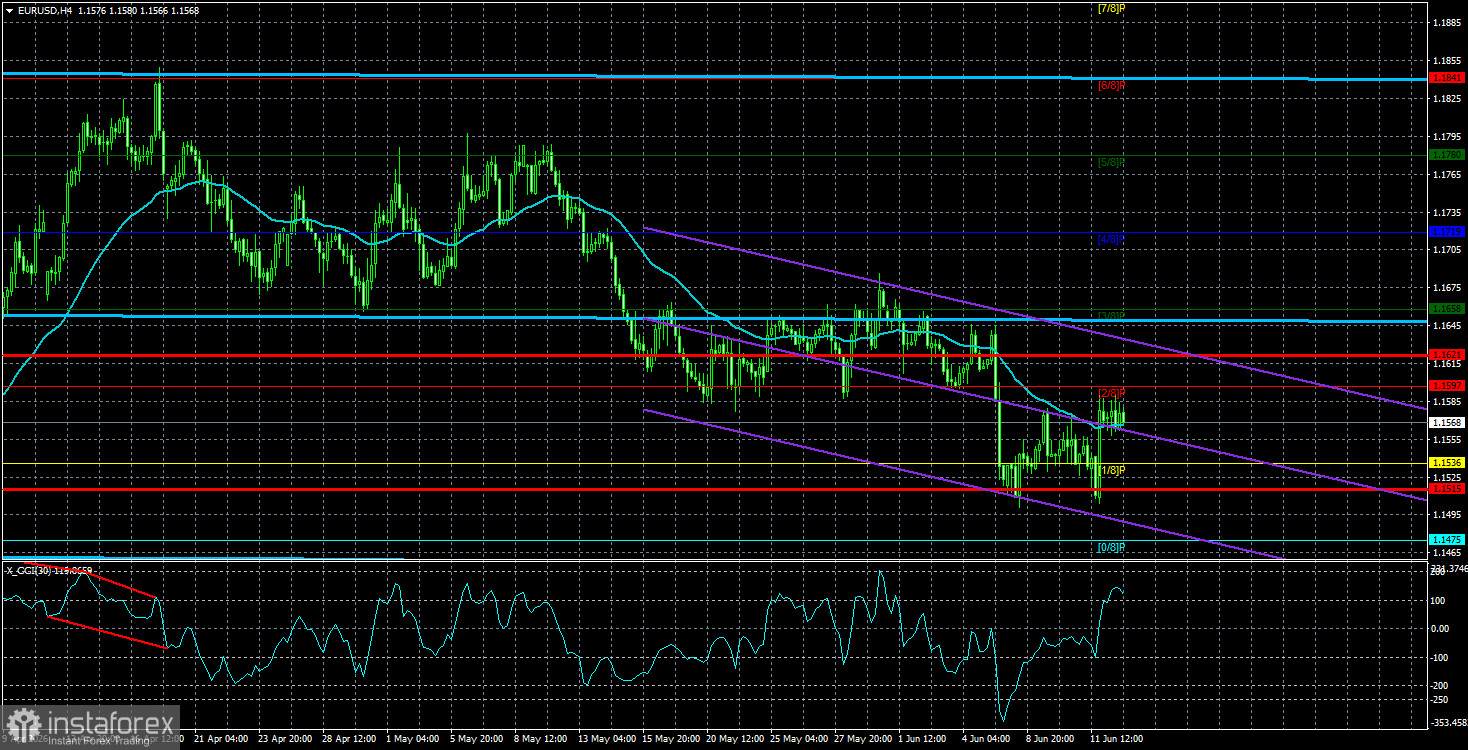
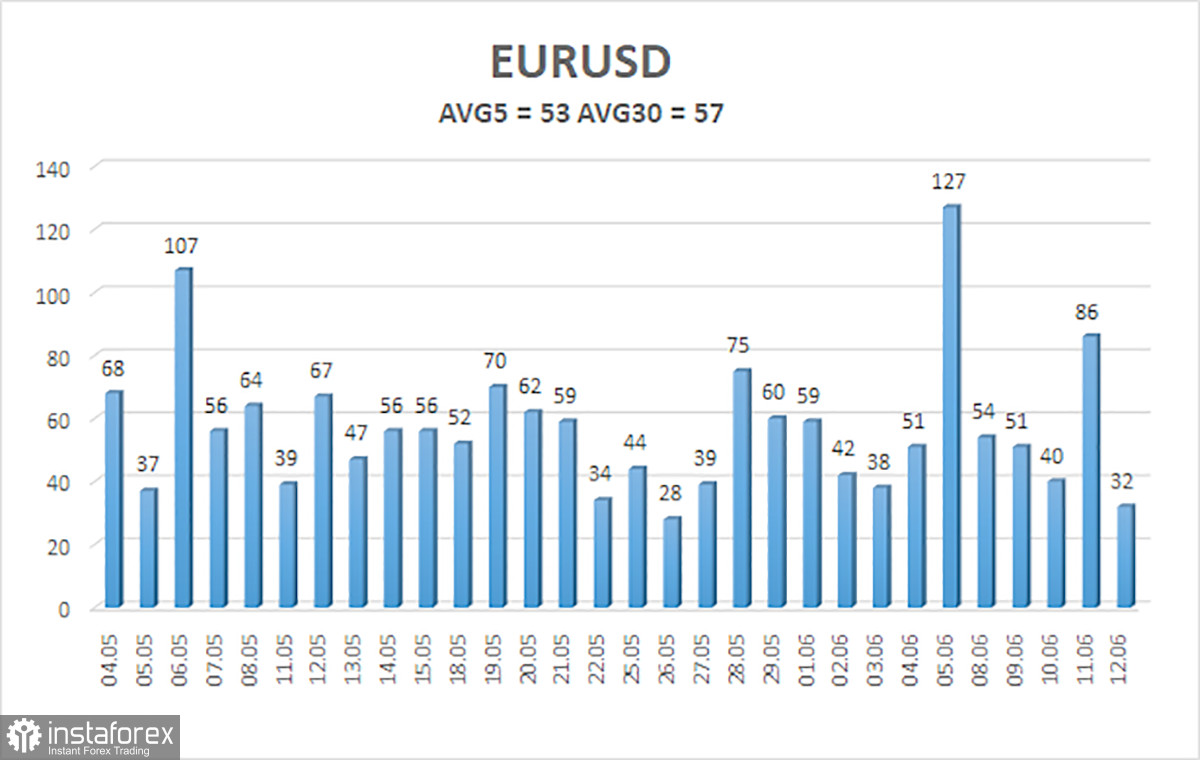
The average volatility of the EUR/USD currency pair over the last 5 trading days as of June 14 is 53 pips, which is considered "average." We expect the pair to move between levels 1.1515 and 1.1621 on Monday. The upper channel of linear regression has turned upwards, indicating a shift to an upward trend. The CCI indicator has entered the overbought area and has formed two "bearish" divergences, warning of the onset of a downward correction that is still not complete. It last entered the oversold area, indicating a possible completion of the correction.
Nearest support levels:
S1 – 1.1536
S2 – 1.1475
S3 – 1.1414
Nearest resistance levels:
R1 – 1.1597
R2 – 1.1658
R3 – 1.1719
Trading Recommendations:
The EUR/USD pair continues its downward movement, presumably a correction within the global upward trend. The overall fundamental backdrop for the dollar remains extremely negative, and only geopolitical factors regularly support it. When the price is below the moving average, short positions can be considered with targets of 1.1515 and 1.1475. Above the moving average line, long positions are relevant with targets of 1.1719 and 1.1780. The market continues to move away from geopolitical factors, but in recent weeks the dollar has been in demand as hopes for peace in the Middle East have weakened.
Explanations for Illustrations:
Linear regression channels help determine the current trend. If both are directed in the same way, the trend is strong right now;
The moving average line (settings 20,0, smoothed) defines the short-term trend and the direction in which trading should currently be conducted;
Murray levels – target levels for movements and corrections;
Volatility levels (red lines) – a probable price channel in which the pair will spend the next day, based on current volatility indicators;
The CCI indicator – its entry into the oversold area (below -250) or into the overbought area (above +250) means a trend reversal in the opposite direction is approaching.